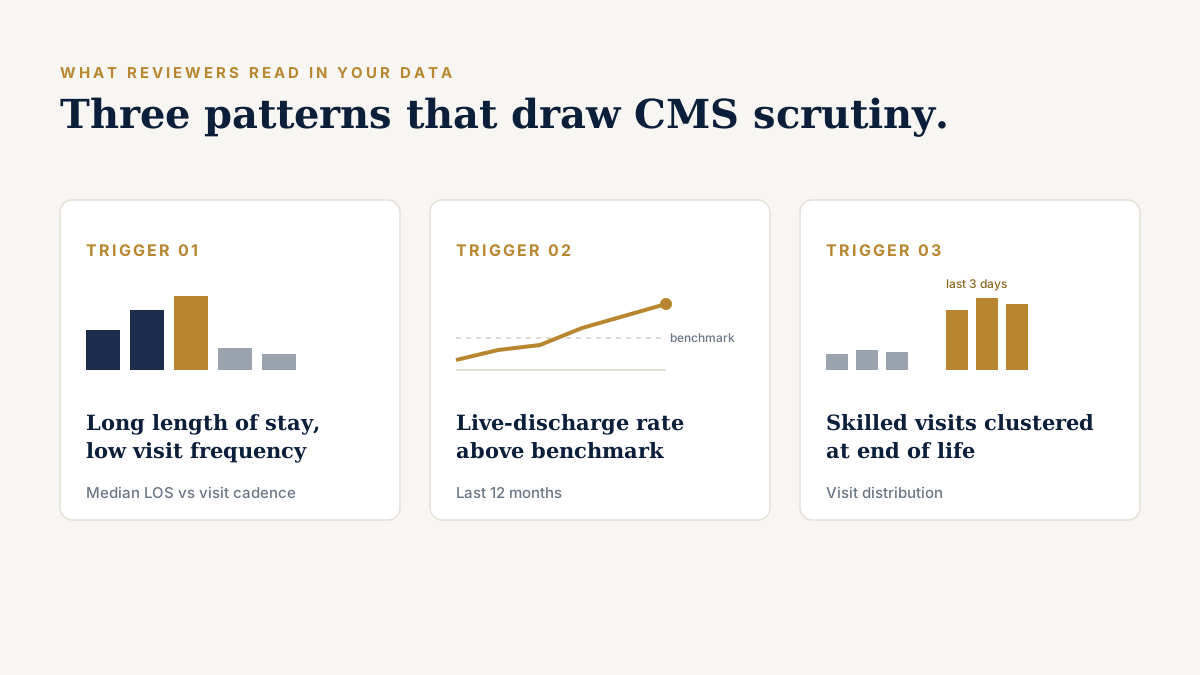
Long length of stay paired with low visit frequency
Commonly interpreted as inappropriate hospice election or care that does not match the terminal prognosis on file. The pattern lives in the gap between the certification language and the visit log.
A 30 minute diagnostic for hospice and home health agency owners who already operate. Read where CMS attention is heading, before it lands on you.
The moratorium does not apply to existing operators. What it tells you about where CMS is heading next does.
CMS moved hospices to the "high" screening tier in 2024. Deeper scrutiny on enrollment, ownership changes, and post-enrollment review. Permanent posture.
A sale inside 36 months triggers a new enrollment and a new survey. The quick flip is closed. Acquiring operators inherit the survey timeline.
AZ, CA, NV, TX, OH, GA are on the watch list now. CMS stated fraud migrates. The exposure is documentation and care pathway, not marketing.
Source: CMS-6102-N (91 FR 27946) hospice moratorium and CMS-6101-N (91 FR 27954) HHA moratorium, both effective May 13, 2026.
Three signals from current market activity. Each one maps to where CMS attention is heading next.
Each acquisition triggers a new enrollment and a new survey under the 36-month ownership rule. Buyers inherit the scrutiny timeline. The moratorium has not slowed M&A — it has changed who bears the compliance risk when a deal closes.
No new post-acute supply entering the market means CMS scrutiny concentrates on existing operators rather than new entrants. The agencies that survive the current cycle are the ones whose record holds under review, not the ones that grow fastest.
The documentation standard reviewers use to evaluate goal-concordant care is the same standard contractors read when auditing hospice election criteria. Agencies whose clinical narrative aligns with care delivered are better positioned in both contexts.
These are the patterns that drive the bulk of contractor referrals on hospice and HHA records. The diagnostic reads each one against your last 12 months and shows how a reviewer would commonly interpret the same numbers.
Commonly interpreted as inappropriate hospice election or care that does not match the terminal prognosis on file. The pattern lives in the gap between the certification language and the visit log.
Commonly interpreted as admission of patients who were not hospice eligible, with the discharge as the reviewer's evidence. The driver is often documentation inside care coordinator workflows, not admission criteria.
Commonly interpreted as care intensity timed to billing windows rather than to clinical need. The defense lives in the clinical narrative, not the visit count.
Four things covered in order. One page summary delivered the same day. The engagement after is optional, the answer is not.
As CMS reviewers commonly read them. Specific. Named. Mapped to your data.
The gap making the pattern look worse than it actually is, identified inside your existing workflows.
The specific change that closes the gap, written so a care coordinator or QA lead can execute on it.
To harden your record before CMS attention reaches your operation. Three phases, 30 days each.
Start at the answer. The booking confirmation includes the data intake form.
MD, MBA. Career inside hospitals and health systems. I read both languages, documentation and data. That is what the diagnostic runs on.
Admissions problem. Live discharge rate 11 points above regional benchmark. Convinced the fix was tightening intake criteria.
Documentation gap inside two care coordinator workflows. Appropriate discharges reading as inappropriate ones. The 90 day sequence fixed the record, not the admissions. Agency stayed intact.
Free consultations are sales calls. This is not a sales call. You are paying for the answer.
30 minutes. One on one. Delivered by end of day.
Top 3 audit triggers. Documentation gap analysis. 90 day hardening sequence. Physician executive only, no staff, no junior associates.
If you decide to engage afterward, the diagnostic fee credits toward the engagement. If you decide not to, you keep the one page diagnostic summary and the 90 day sequence outline. Either way, you walk away with the answer.
The moratorium is a leading indicator, not a final action. Under the existing PPEO, 18 percent of hospices CMS reviewed were revoked. That is the cycle CMS just signaled it intends to widen. The diagnostic reads where the scrutiny lands next, on your data, not in general.
Because you are paying for the answer, not the conversation. Most operators have asked their consultants this question and gotten generalities. The diagnostic exists so you get the specifics on your own data inside 30 minutes.
Yes. The booking confirmation includes the data intake form. I review it before the call so we start at the answer, not at the question.
Yes. The moratorium is nationwide and CMS explicitly stated in the May 13 notice that hospice fraud migrates geographically. The state level oversight is in addition to the national scrutiny, not instead of it.
That is exactly what the diagnostic produces. The engagement is optional. You walk away with the one page diagnostic summary and the 90 day sequence outline whether you hire me or not.
Four signals indicate elevated risk: your live discharge rate is above your regional benchmark, your length of stay is long relative to your visit frequency, you have had a contractor or MAR reviewer in your market in the last 12 months, or you have had an ownership change in the last 36 months. Any one of these patterns is worth reading before CMS does. The diagnostic reads all four against your last 12 months of data.
A standard compliance review checks whether your documentation meets a checklist. This diagnostic reads your operational data the way a CMS contractor would — identifying the patterns that trigger referrals, not just the policies that are missing. The output is the specific gap between your data and how a reviewer reads it, mapped to a 90-day correction sequence. It is diagnostic in the clinical sense: find the cause, not just the symptom.
You have two options. First, you implement the sequence on your own — it is written so your compliance lead or care coordinator can execute each step. Second, you engage A3HCS for the implementation. If you move into an engagement, the $2,500 diagnostic fee credits toward the project. If you do not, you keep the full one-page summary and the 90-day outline. Either way, you walk away with the answer.
You are paying for the answer, not the conversation. Submit the form, and the founder confirms the booking with the data intake form attached. Your top 3 audit triggers, the gap analysis, and the 90 day sequence land in your inbox by end of day of the call.
A small number of operators per quarter. When this quarter fills, the next opening is 90 days out. Get the answer now and decide from there.
Book the 30 Minute Diagnostic →