Diagnostic-First Advisory

Know before you act. Every engagement starts here.

A3HCS structures every engagement around a diagnostic first. The cost of acting on the wrong read is paid by your patients, your margin, and your team's credibility. Below are the current active diagnostics.

NewsHX Healthcare Intelligence Current . May 2026

What is driving healthcare compliance pressure right now.

Three active signals across regulatory, coverage, and post-acute domains. Each one maps to a diagnostic A3HCS runs.

Regulatory Compliance

No Surprises Act dispute resolution finalized — IDR fees drop from $115 to $15, creating new arbitration pressure across provider operations

The finalized rule overhauling the No Surprises Act dispute process compresses costs while increasing arbitration volume. Providers already winning lawsuits against insurers. For hospital and health system operators, this signals sustained compliance and legal overhead inside revenue cycle operations.

Modern Healthcare May 28, 2026
Coverage Pressure

Uninsured rate holds at 8.3% as Medicaid cuts loom — coverage uncertainty accelerates hospital revenue cycle risk and margin compression

The number of uninsured residents is expected to rise as Medicaid and ACA exchange subsidies come under pressure. For hospitals and health systems, a rising uninsured rate translates directly to uncompensated care volume and a harder collections environment. The pressure is structural, not cyclical.

Modern Healthcare May 28, 2026
Post-Acute Scrutiny

CMS moratorium effective May 13 signals widening post-acute scrutiny — the 18% hospice revocation rate under PPEO is the baseline for the next cycle

The hospice and HHA enrollment freeze is a leading indicator of where CMS enforcement is heading next. The 18% revocation rate under PPEO review — against a 1–3% baseline across all provider types — tells operators that post-acute is under a different standard. The diagnostic reads where that standard lands on your data.

CMS-6102-N (91 FR 27946) May 2026
Source: NewsHX Healthcare Intelligence newshx.com Healthcare Policy and Compliance Feed
Not sure which diagnostic fits? Start with a free 20-minute scoping call. We pressure-test the problem and point you to the right entry.
Book a Call →
Now Live Regulatory Response

Hospice & HHA Diagnostic

$2,500 Flat fee · credited to engagement

A 30-minute paid diagnostic for hospice and home health agency owners navigating CMS scrutiny. Read your top audit triggers, gap analysis, and a 90-day sequence — on your data, delivered by end of day. Built in direct response to the May 13, 2026 moratorium.

  • Audit trigger read against CMS patterns
  • Gap analysis on your operational data
  • 90-day response sequence
  • Run by MD, MBA — no junior staff
Read the Full Diagnostic →
Compliance Tool

HIPAA Security Gap Checklist

Free Gated — unlock with email

A structured self-assessment against the HIPAA Security Rule (45 CFR Part 164), updated to include proposed 2025 NPRM changes. Score your posture across Administrative, Physical, Technical, and Organizational safeguards.

  • Administrative safeguards (§164.308)
  • Physical safeguards (§164.310)
  • Technical safeguards (§164.312)
  • 2025 NPRM proposed updates included
Access the Checklist →
Cyber Risk · Tier 01

Rapid Snapshot

$3,500 Flat fee · delivered in 5 business days

A structured read of your HIPAA Security Rule posture using the A3 Scan Engine. Findings translated from technical language into a board-ready memo — because the next ransomware event is a patient safety event, not just an IT incident.

  • A3 Scan Engine risk read
  • Board-ready memo format
  • Prioritized remediation path with owners
  • No retainer required to start
See Cyber Risk Advisory →
Engagement Formats . § 06

Four ways to work with A3HCS.

Most engagements start with the diagnostic. From there, the format follows the work. Project-based for defined execution, retainer for ongoing senior counsel, board-level for episodic strategic reads.

Format 01 2 to 4 weeks

Diagnostic

A structured assessment delivered as an executive memo. Defines where time, margin, and trust are leaking. Most engagements start here.

  • Interviews & data pull
  • Variance & peer comparison
  • Executive memo
  • Correction path recommendations
Format 02 8 to 16 weeks

Project

A defined scope of execution work. Liaison program build, protocol redesign, partner negotiation, or workflow integration. Fixed deliverables.

  • Defined scope & milestones
  • Operating-partner collaboration
  • Implementation artifacts
  • Tracked-metric handoff
Format 03 Quarterly

Retainer

Senior counsel on call for executive teams. A standing cadence for strategy, escalation, and second-opinion work. Pre-negotiated hours.

  • Monthly executive sessions
  • Strategic memo on request
  • Escalation availability
  • Defined hours per quarter
Format 04 Engagement-specific

Board Advisory

Episodic engagement for boards, investors, and CEOs. Clinical diligence, capital deployment reads, service line strategy, and acquisition reviews.

  • Clinical diligence reads
  • Board presentations
  • Acquisition reviews
  • Service line strategy
Common Questions

How diagnostics work.

What is a diagnostic engagement at A3HCS?
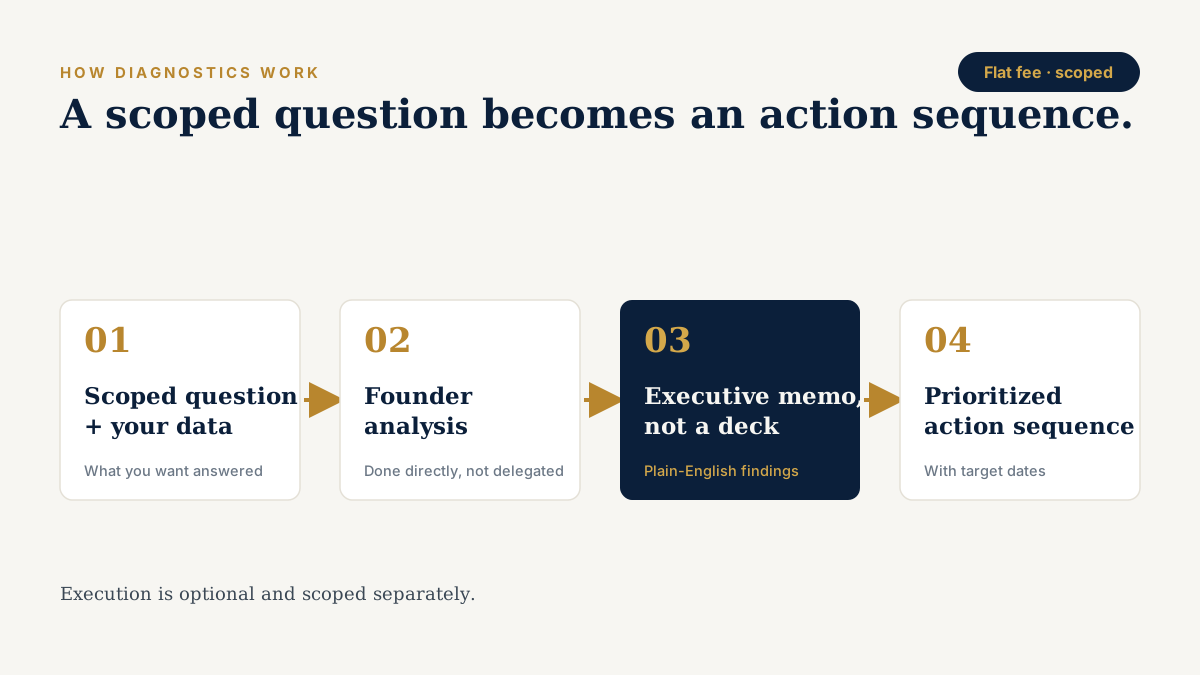
A diagnostic is a structured assessment — typically 2 to 4 weeks — that identifies where time, margin, or compliance posture is at risk. It delivers an executive memo, not a slide deck. Most engagements start here before any execution work begins.
Do I have to commit to a longer engagement after the diagnostic?
No. Every diagnostic is a standalone flat-fee engagement. There is no automatic continuation. If you want to move into a project or retainer after the diagnostic, that is a separate scoped conversation.
Are these diagnostics run by the founder directly?
Yes. Nitesh Kumar, MD, MBA runs every diagnostic personally. No junior associates. No staffed delivery teams. One operator across every engagement.
What types of healthcare organizations use A3HCS diagnostics?
Hospitals and health systems facing operational or revenue cycle pressure, hospice and home health agency owners navigating CMS scrutiny, pharma and medtech companies needing medical affairs support, and pre-seed to Series B digital health founders. Each diagnostic is scoped to the buyer, not a generic template.
What does a diagnostic executive memo actually include?
The memo names the top three operational or compliance exposure points, maps each one to your specific data, identifies the documentation or workflow gap making each pattern worse than it needs to be, and delivers a prioritized 90-day correction sequence with named owners. It is written to be read by a board or C-suite, not a compliance team.
How is a diagnostic different from a standard healthcare consulting engagement?
A standard consulting engagement is open-ended scope, hourly billing, and a team of junior associates. A3HCS diagnostics are flat fee, defined scope, time-bounded, and run by one physician executive. The output is a memo, not a deck. You know what you are buying before you pay.
Which diagnostic should I start with?
Start with the problem that is costing you now. If you are a hospice or HHA operator and the CMS moratorium is in your market, start with the Hospice and HHA Diagnostic. If you received a breach notification or cyber incident, start with the Cyber Risk Snapshot. If you are not sure, the general diagnostic inquiry form routes to the right entry point within two business days.
How do I know if my organization needs a diagnostic?
If any of the following are true, a diagnostic is the right starting point: a regulatory notice or contractor activity in your market, a financial metric that looks wrong but you cannot isolate the cause, an upcoming ownership change or survey, a recent data breach or HIPAA incident, or a board that has asked a question you cannot fully answer yet.
Primary CTA . § 12

Request a Care Transition and Growth Diagnostic.

A two-to-four-week structured diagnostic delivered as an executive memo, not a deck. It defines where your system is losing time, margin, and trust, and identifies the two-to-three corrections worth investing in next.

  • Structured interviews with operational and clinical owners
  • Data pull and variance analysis against peer benchmarks
  • System map of friction points across the continuum
  • Executive memo with prioritized correction paths
  • No findings before facts. No outcome guarantees. Clear scope.